
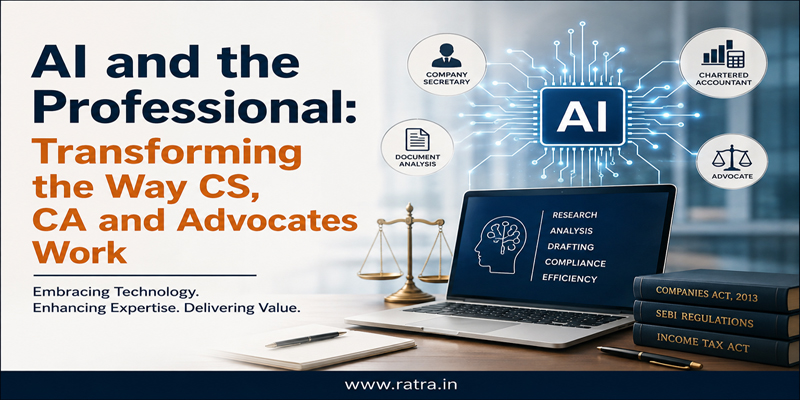
AI and the Professional: Transforming the Way CS, CA and Advocates Work

August 20, 2026
Artificial Intelligence (“AI”) is no longer a futuristic concept confined to technology companies. It is rapidly becoming a practical working tool across professional services. Company Secretaries (CS), Chartered Accountants (CA), Advocates and other professionals are increasingly using AI to research, analyse, draft, review and organise information.
The important question, therefore, is no longer whether professionals should use AI, but how they should use it responsibly and effectively.
AI should not be viewed as a substitute for professional expertise. Rather, it should be regarded as a powerful professional assistant—capable of processing large volumes of information, identifying patterns, preparing first drafts and undertaking repetitive tasks, while leaving professional judgment, accountability and decision-making with the professional.
Where Can Professionals Use AI?
The potential applications are extensive.
For a Company Secretary, AI can assist in analysing provisions of the Companies Act, SEBI regulations and other corporate laws; preparing first drafts of notices, resolutions, minutes, letters and disclosures; comparing amendments; preparing compliance checklists; reviewing corporate documents; summarising regulatory circulars and judgments; and identifying potential compliance issues.
For a Chartered Accountant, AI can assist in analysing financial statements, identifying unusual trends or transactions, preparing management reports, reviewing accounting documents, drafting communications, analysing large datasets and supporting tax and regulatory research.
For an Advocate, AI can assist with legal research, summarising judgments, identifying relevant provisions and precedents, reviewing contracts, preparing chronologies, comparing pleadings and documents, and developing an initial structure for legal submissions.
These are not merely theoretical possibilities. Generative AI is already being used in professional environments for drafting, document analysis, research and administrative work, with significant potential productivity gains.
How AI Can Add Efficiency and Capability
The greatest advantage of AI is not simply that it can “write”. Its real value lies in its ability to reduce the time required for information-intensive work.
A professional may spend hours reading a lengthy circular, agreement, judgment or set of financial documents. AI can provide an initial summary within minutes, identify important clauses, highlight differences between two documents or prepare a list of issues requiring attention.
Similarly, instead of starting a document from a blank page, the professional can use AI to prepare a first draft and then apply his or her own expertise to modify, verify and finalise it.
AI can therefore improve professional productivity in several ways:
First, saving time: Routine drafting, summarisation, comparison and information extraction can be completed considerably faster.
Second, handling volume: AI can review large numbers of documents or large datasets much more quickly than a human working manually.
Third, improving consistency: Standard formats, checklists, compliance trackers and recurring communications can be prepared more consistently.
Fourth, supporting research: AI can help identify relevant legal provisions, concepts, issues and areas requiring further investigation.
Fifth, enhancing capability: A professional can use AI as a “second pair of eyes” to identify issues that may otherwise be overlooked.
The objective should therefore be not to replace professional thinking but to augment it.
AI as a “Co-Pilot”, Not the Decision Maker
The most effective model is a human-in-the-loop approach.
The professional should define the problem, provide appropriate instructions, critically evaluate the AI output, independently verify important facts and authorities, apply professional judgment and finally take responsibility for the advice or document issued.
This distinction is particularly important in professional practice. AI can generate a convincing answer even when the underlying answer is incorrect. Generative AI systems may produce inaccurate information, incorrect interpretations or “hallucinated” case laws and citations. Indian courts have already expressed serious concern regarding reliance on AI-generated or non-existent judgments.
Accordingly, an AI-generated answer should always be treated as a draft or starting point—not as professional advice.
Risks and Precautions
The benefits of AI come with corresponding risks.
1. Accuracy and Hallucination
AI may confidently provide an incorrect answer. It may misstate a statutory provision, quote an outdated regulation or even cite a judgment that does not exist.
Therefore, every material legal, financial, tax or regulatory conclusion must be independently verified from the original legislation, notification, circular, judgment or authoritative source before it is relied upon.
2. Confidentiality and Data Protection
This is perhaps the most important practical concern.
Professionals routinely deal with confidential information—client financial data, unpublished corporate information, litigation strategy, personal data, transaction documents and commercially sensitive information.
Such information should not be casually uploaded into a public AI platform. Before using an AI tool, professionals should understand its data-handling arrangements, retention policy, security measures, access controls and terms of use.
For advocates, confidentiality is a fundamental professional obligation. The Bar Council of India specifically recognises the duty of an advocate not to disclose communications between the client and the advocate.
3. Professional Responsibility
Using AI does not transfer responsibility from the professional to the software provider.
If an AI-generated error results in an incorrect filing, defective advice or inaccurate submission, the professional cannot simply argue that “AI generated it”.
The professional remains responsible for the final work product.
4. Overdependence on AI
There is also a less visible danger—loss of professional judgment.
A young professional who routinely accepts AI-generated answers without understanding the underlying law or accounting principles may become dependent on the technology. AI should therefore be used to strengthen knowledge, not to replace learning and professional development.
5. Intellectual Property and Confidential Information
Professionals should also consider whether documents, proprietary material or third-party content can legitimately be uploaded into an AI system and how generated material may be used.
A clear internal AI policy covering permitted tools, confidential information, verification requirements and approval procedures can substantially reduce these risks.
Will AI Replace CS, CA or Advocates?
The short answer is unlikely—but AI will replace many tasks currently performed by professionals.
A machine can analyse a document, summarise a judgment, prepare a draft resolution or identify accounting anomalies. But professional work involves much more than processing information.
A CS has to understand the business context and advise the Board on the appropriate course of action. A CA must exercise professional judgment in complex financial and accounting matters. An Advocate must understand the client’s objectives, develop strategy, assess facts, persuade a court or negotiate with the opposing side.
These functions involve judgment, experience, ethics, communication, accountability and human understanding.
The more realistic future is therefore not “AI versus professionals”, but “professionals using AI versus professionals who do not.”
Ultimately, AI will not replace professionals. However, professionals who use AI will inevitably replace professionals who do not. The future belongs to the augmented practitioner who blends deep statutory expertise with high-velocity digital capabilities.
The Way Forward
Professionals should neither blindly embrace AI nor resist it.
The appropriate approach is responsible adoption.
Professionals should start with low-risk applications such as summarisation, formatting, brainstorming, document comparison and preparation of preliminary drafts. As familiarity increases, AI can be integrated into more sophisticated workflows, subject always to appropriate safeguards.
Professional firms and organisations should consider establishing an AI usage policy, including:
- approved AI tools and platforms;
- categories of information that may and may not be uploaded;
- mandatory verification of AI-generated outputs;
- human approval for client-facing or regulatory documents;
- confidentiality and data-security requirements; and
- periodic training on responsible AI usage.
The emergence of AI is comparable to earlier technological changes that transformed professional practice—from computers and spreadsheets to electronic filing and cloud-based systems. Those technologies did not eliminate professionals; they changed the way professionals worked.
AI is likely to do the same, but on a much larger scale.
Conclusion
AI is neither a magic solution nor a threat that professionals should fear. It is a powerful tool whose value depends upon the person using it.
For CS, CA and Advocates, the winning approach will be to combine the speed and analytical capability of AI with human expertise, professional judgment and ethical responsibility.
The professional of the future may not be the person who knows everything. It may be the person who knows what to ask AI, what to trust, what to verify, and when human judgment must prevail.
The objective should therefore be simple:
Let AI do more of the work—but let the professional remain responsible for the work that matters.
Disclaimer: This article is intended solely for general information and knowledge-sharing purposes and should not be construed as professional, legal, financial, tax or other expert advice. While reasonable care has been taken in preparing the contents, readers should independently verify the applicable law, regulations, facts and circumstances before relying upon any information or AI-generated output discussed herein. The author does not assume responsibility for any action taken or omitted based on the contents of this article.